

Image Details
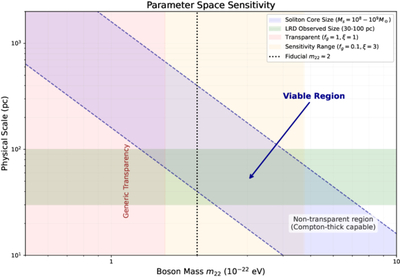
Caption: Figure 1.
Constraints on boson mass (m22) from combining the soliton size scaling (Equation (1)) with an opacity (column) requirement. The vertical axis shows a characteristic physical scale; we compare the observed effective radius range of LRDs (green band, re ∼ 30–100 pc) with the soliton core radius predicted for Ms = 108–109 M⊙ (blue band; dashed boundaries follow ﹩{r}_{c}\propto {m}_{22}^{-2}﹩). The red region marks parameters for which even a maximally loaded core (fg ≈ 1) confined within re ≈ rc with ξ ≈ 1 cannot reach NH ≈ 1024 cm−2,. The opacity boundary is evaluated for a representative Ms ∼ 109 M⊙ (typical of LRD hosts). The orange shaded area illustrates sensitivity to baryon loading uncertainties by adopting conservative values (fg = 0.1, ξ = 3). The viable region is the overlap between the observed size band and the nontransparent (Compton-thick-capable) region; the region outside the red shaded area corresponds entirely to the nontransparent (Compton-thick capable) regime. The “viable region” is specifically the parallelogram defined by the overlap between the observed size band and this nontransparent regime. Under the direct-mapping assumption (re ∼ rc), this favors m22 ∼ few, and we adopt m22 = 2 as a fiducial baseline for subsequent figures.
Other Images in This Article
Copyright and Terms & Conditions
© 2026. The Author(s). Published by the American Astronomical Society.

