

Image Details
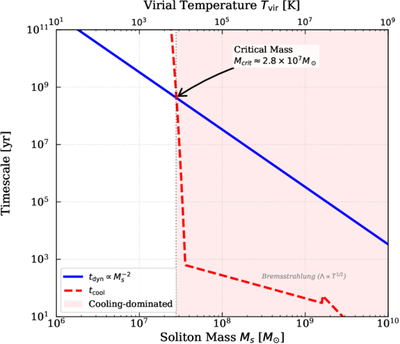
Caption: Figure 2.
Timescale hierarchy in soliton cores. Comparison between the dynamical time tdyn (blue solid line, ﹩{t}_{{\rm{dyn}}}\propto {M}_{s}^{-2}﹩) and the optically thin cooling time tcool (red dashed line; this corresponds strictly to the optically thin cooling time defined in Equation (5), not the effective diffusion-limited time trad) as a function of soliton mass Ms. The top axis explicitly provides the corresponding virial temperature Tvir to guide physical intuition. At low masses (Tvir < 104 K), the exponential suppression of atomic cooling in primordial gas leads to a stable regime where tcool > tdyn. As the soliton mass increases, the gas is heated above the atomic cooling threshold, causing a sharp drop in tcool. A critical mass emerges at Mcrit ≈ 2.8 × 10⁷M⊙, identified exactly at the intersection where the condition tcool = tdyn is satisfied; this threshold is obtained analytically by solving tcool = tdyn using the cooling function adopted in our model (see Appendix B). Above this mass threshold, the system enters the cooling-dominated regime (tcool < tdyn). For the massive regime relevant to LRDs (Ms ≳ 108M⊙), the cooling time is orders of magnitude shorter than the dynamical time, inevitably triggering a catastrophic collapse.
Other Images in This Article
Copyright and Terms & Conditions
© 2026. The Author(s). Published by the American Astronomical Society.

