

Image Details
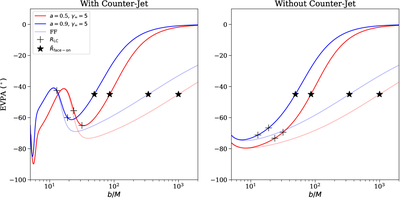
Caption: Figure 3.
EVPA of a face-on jet, again including fully general relativistic effects. On the left, the results are shown when a counterjet is present (thus matching Figure 2), and on the right, the results are shown when a counterjet is not present. In each panel, polarization curves are plotted for two different spins (a = 0.5 and a = 0.9) and terminal Lorentz factors (γ∞ = 5 and force free). When a counterjet is present, the polarization curve always shows a sharp swing at the light cylinder (marked with black crosses), regardless of the terminal Lorentz factor. But when the counterjet is not present, the polarization angle swings more modestly at the true light cylinder, meaning that ﹩\tilde{R}﹩ (shown as a star) can serve as a more easily identifiable metric.
Other Images in This Article
Show More
Copyright and Terms & Conditions
© 2026. The Author(s). Published by the American Astronomical Society.

