

Image Details
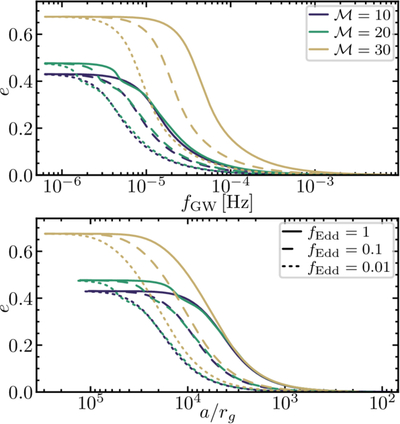
Caption: Figure 11.
Illustrative tracks of SMBH binary eccentricity as a function of semimajor axis and the roughly millihertz GW frequencies (plotted here without cosmological redshift) that will be probed by LISA and other space-based GW interferometers. As an example, these calculations assume binaries with m = 105 M⊙. These calculations assume accretion at various fractions of the Eddington rate (with mass e-folding timescales of 5 × 10⁷−9 yr) and the corresponding changes in orbital evolution estimated in Section 3.2 due to accretion disks of various thicknesses, as well as the leading-order effects of GW emission (P. C. Peters 1964). Binaries will enter the LISA band with high eccentricities (to an extent that depends on disk thickness) and gradually circularize as they approach merger.
Other Images in This Article
Show More
Copyright and Terms & Conditions
© 2026. The Author(s). Published by the American Astronomical Society.

