

Image Details
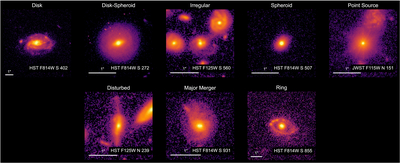
Caption: Figure 8.
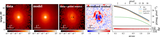
Top row: Examples of primary visual classifications. Bottom row: Examples of secondary classifications. The telescope, filter, field, and CDF source ID are shown for each source. Every galaxy in our sample was given a primary classification; secondary classifications were awarded as necessary to provide additional context about interacting galaxies. Disturbed is the lowest-priority secondary classification. For example, if a galaxy is clearly in a major merger (as indicated, for example, by the dual nucleus shown in the figure), then the major merger secondary classification is given in lieu of disturbed. Nearly all major mergers show disturbances (nuclear asymmetry, tidal features, etc.), but not all disturbances are indicative of a major merger.
Other Images in This Article
Show More
Copyright and Terms & Conditions
© 2026. The Author(s). Published by the American Astronomical Society.

