

Image Details
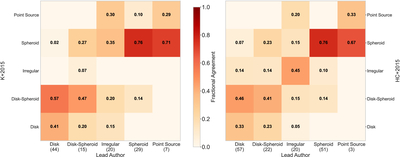
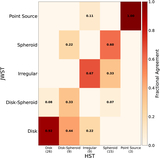
Caption: Figure 11.
A 2D histogram comparing visual-like morphological classifications from (1) M. Huertas-Company et al. (2015) and (2) J. S. Kartaltepe et al. (2015) with visual classifications from the lead author. Note: 67/194 of the lead author’s classifications are from JWST, with the remainder from HST. Both classifiers agree very well for bulge-dominated (spheroid and PS) galaxies. We generally agree whether a source is disk-dominated, but do not agree specifically about whether a spheroidal or halo component is prominent beside the disk. This is not surprising, since the disk-spheroid category is the most “subject to interpretation” category within our classification scheme. Note also that irregulars show low agreement (45% with M. Huertas-Company et al. 2015, 0% with J. S. Kartaltepe et al. 2015). There are several reasons for this: irregular galaxies constitute a wide range of morphological properties from small with large asymmetries to those undergoing major mergers. Irregular indicators such as tidal streams are also faint, and if they are not sought out, they can remain hidden from studies that do not explicitly look for them. We note that 100% of this work’s visually classified irregular galaxies show evidence of disturbances or major mergers, improving our confidence in our classification of these sources.
Other Images in This Article
Show More
Copyright and Terms & Conditions
© 2026. The Author(s). Published by the American Astronomical Society.

