

Image Details
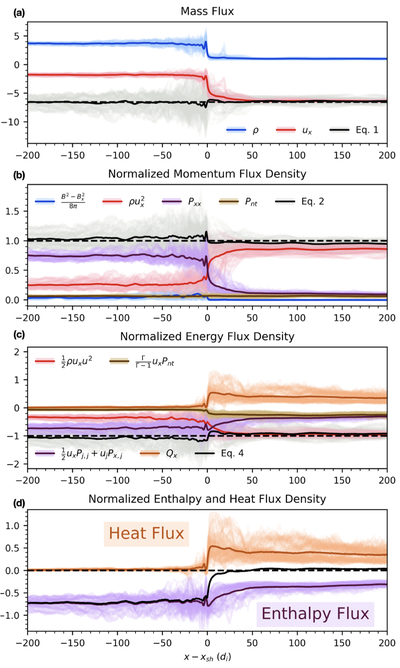
Caption: Figure 3.
Time-averaged RH jump conditions. One-dimensional cuts are normal to the shock and centered around the shock front, and are time-averaged as discussed in Figure 1. The black lines in each of the panels correspond to the sum of the fluxes in Equations (1), (2), and (4) for panels (a), (b), and (c), respectively. The colored lines correspond to the different terms in each of the equations, and the brown lines show the nonthermal contribution to the pressure and enthalpy flux density separately. Panel (d) shows the sum (black line) of the heat flux density (orange) and the total enthalpy flux density (purple). The two almost perfectly counterbalance each other in the upstream region, showing that the upstream nonthermal particles do not contribute to the jump conditions.
Other Images in This Article
Copyright and Terms & Conditions
© 2026. The Author(s). Published by the American Astronomical Society.

