

Image Details
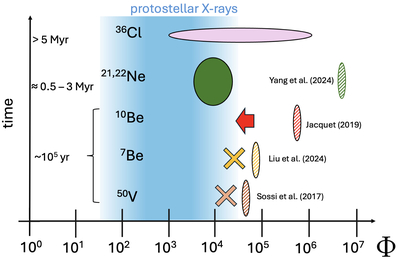
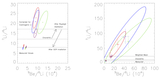
Caption: Figure 5.
Constraints on Φ (the factor by which the SEP flux was enhanced above the present-day value, 100 cm−2 s−1 particles with E > 10 MeV nucleon–1 at 1 au), from various meteoritic data. P. A. Sossi et al. (2017) suggested Φ ≈ 6 × 10⁴ from V isotope anomalies in CAIs, refuted by D. V. Bekaert et al. (2021), who showed these are attributable to evaporation. M.-C. Liu et al. (2024) argued for Φ ≈ 9 × 10⁴ based on a presumed abundance of 7Be in one CAI. Our refutation of its existence (Section 6) renders this constraint moot. E. Jacquet (2019) argued for Φ ≈ 9 × 10⁵ based on perceived heterogeneities in 10Be/9Be ratios among CAIs. Our demonstration that 10Be/9Be ratios were homogeneous at 7 × 10⁻⁴ (Section 5) puts a limit Φ ≪ 105 for how much 10Be was created by irradiation. X. Yang et al. (2024) argued for an exceptionally high value Φ = 6 × 10⁶ based on their interpretation of how cosmogenic Ne was produced in hibonite grains. Our modeling (Section 4) demonstrates that the Ne likely was produced in a disk subject to Φ ≈ 3 × 10³ to 2 × 10⁴. Finally, our modeling of 36Cl production after disk dissipation (Section 3) demands Φ < 106, possibly ≈103, depending on the chemical composition of ice. No meteoritic data demand values greater than Φ ≈ 3 × 10³, which makes the proto-Sun consistent with the range Φ ≈ 3 × 10² to 3 × 10³ inferred from X-ray observations of protostars (S. J. Wolk et al. 2005) in the shaded bars (which include some uncertainty about the proton flux per X-ray flux). The early Sun appears to have been a typical protostar, and data or models suggesting otherwise should be scrutinized.
Other Images in This Article
Copyright and Terms & Conditions
© 2026. The Author(s). Published by the American Astronomical Society.

