

Image Details
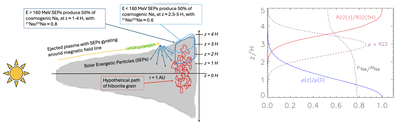
Caption: Figure 2.
Left: cartoon depicting how hibonite grains acquire cosmogenic Ne. SEPs in a stellar wind gyrate around the magnetic field lines and can enter the disk in an isotropic way where the wind impinges on the disk. Lower-energy (E < 160 MeV) protons (light blue) are more readily absorbed, and generate cosmogenic Ne with 21Ne/22Ne ≈ 0.6, only from 2.5 to 5H; but higher-energy protons (dark blue) penetrate farther and generate Ne 21Ne/22Ne ≈ 0.8, from 1 to 4H. Hibonite grains diffuse vertically (red trajectories) and spend time at various heights z above the midplane. Right: variation of 22Ne production rate from SEPs of all energies (red solid curve) and the relative time spent by dust grains (blue solid curve) as a function of height z above the midplane. The product (purple dashed curve, here multiplied by 500) illustrates that most cosmogenic Ne is produced between 2 and 4 scale heights above the midplane. Also plotted (dotted curve) is the 21Ne/22Ne ratio of cosmogenic Ne, which is ≈0.52 near the surface (appropriate for unattenuated SEPs) but ≈0.79 near the midplane, where only high-energy SEPs can penetrate. On average, 21Ne/22Ne ≈ 0.67.
Other Images in This Article
Copyright and Terms & Conditions
© 2026. The Author(s). Published by the American Astronomical Society.

