

Image Details
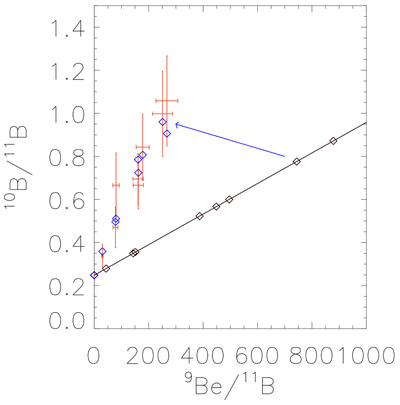
Caption: Figure 3.
Effect on inferred isochron slope of undersubtracting background noise. The data (including 2σ error bars) for CAI Y20-1X1 reported by K. Fukuda et al. (2021) are plotted in red, consistent with ﹩{({\,}^{10}{{\rm{Be}}}/{\,}^{9}{{\rm{Be}}})}_{0}\approx 30\times 1{0}^{-4}﹩. If the ratios actually were arrayed along an isochron (black line) with slope ﹩{({\,}^{10}{{\rm{Be}}}/{\,}^{9}{{\rm{Be}}})}_{0}=7\times 1{0}^{-4}﹩ (black diamonds), producing counts 0.2 ([B]/50 ppb) cps, but the reported measurements inadvertently included unsubtracted noise (0.05 cps), this would result in the reported data having lower 9Be/11B and higher 10B/11B values (blue diamonds), i.e., shifting them in the direction of the arrow. We have chosen the 9Be/11B values of the “real” data to match the reported 9Be/11B values, but the 10B/11B values are an unexpectedly good match. We conclude that the inferences of high ﹩{({\,}^{10}{{\rm{Be}}}/{\,}^{9}{{\rm{Be}}})}_{0}﹩ values for CAIs SA301 (K. Fukuda et al. 2019), and Y20-1X1 and Y20-9-1 (K. Fukuda et al. 2021) are likely artifacts of undersubtracting electronic noise.
Other Images in This Article
Copyright and Terms & Conditions
© 2026. The Author(s). Published by the American Astronomical Society.

