

Image Details
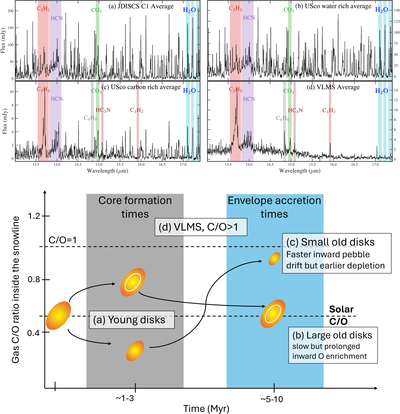
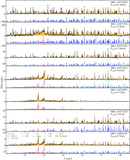
Caption: Figure 11.
Upper panel: comparison of average spectra from the young JDISCS C1 sample, VLMS (M* < 0.2 M⊙, representative of C/O ratio > 1) disks (S. L. Grant et al. 2025), and the millimeter-bright (MR1–MR3) and millimeter-faint (MR5–MR7) disks in the U2970 sample, which have the same spectral type as JDISCS C1. The millimeter-bright USco average spectrum closely resembles the average JDISCS C1 spectrum. In contrast, the millimeter-faint average USco spectrum shows less water and stronger emission from C-bearing molecules but not at the level of the VLMS average spectrum. This suggests an elevated C/O ratio relative to the water-rich disks, but still below one. Lower panel: sketch of the proposed scenario for explaining the behavior, with (a) to (d) corresponding to the four subplots in the upper panel.
(The data used to create this figure are available in the online article.)
(The data used to create this figure are available.)
Other Images in This Article
Show More
Copyright and Terms & Conditions
© 2026. The Author(s). Published by the American Astronomical Society.

