

Image Details
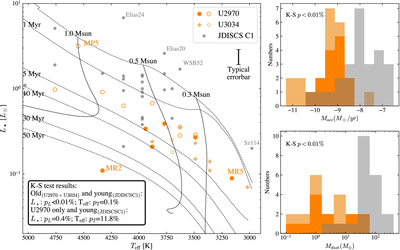
Caption: Figure 1.
Left panel: HR diagram for the USco samples (U2970 in orange and U3034 in light brown), compared with younger sources from the JDISCS Cycle 1 survey (gray; N. Arulanantham et al. 2025). MR and MP disks (see Section 3.1 for the classifications) are denoted with full and empty symbols, respectively. The results of the K-S tests for L* and Teff between the young JDISCS sample and older USco samples are also shown. The whole USco sample is significantly lower in L* and Teff (with K-S p < 5%), but only U2970 (both MP and MR subsamples) has similar Teff as the younger sample (with K-S p > 10%). MR2 is highly inclined and its L* is underestimated (M. Fang et al. 2023). MP5 and MR5 are binary candidates in our JWST/MIRI cubes (see Appendix A for details). Right two panels: accretion rate and dust mass distributions for each sample, with U3034 stacked on top of U2970. The older sample has significantly lower Macc and Mdust than the young sample.
Other Images in This Article
Show More
Copyright and Terms & Conditions
© 2026. The Author(s). Published by the American Astronomical Society.

