

Image Details
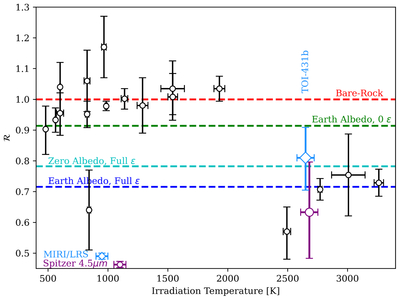
Caption: Figure 4.
Literature values for ﹩{ \mathcal R }﹩ (ratio of the dayside brightness temperature and the theoretical maximum) for all rocky exoplanets with observed dayside temperatures compared to TOI-431b. Dashed horizontal lines show the respective ﹩{ \mathcal R }﹩ values for a bare, dark rock (red), an Earth albedo with zero-heat redistribution (green), zero albedo with full heat redistribution (cyan), and an Earth albedo and full redistribution (dark blue). The ﹩{ \mathcal R }﹩ value derived within this work is plotted as a light blue diamond, and the value derived from C. Monaghan et al. (2025) using 4.5 μm Spitzer observations is plotted as a purple circle and has a 30 K offset for visibility. TOI-431b matches a trend seen in other ultrahot rocky exoplanets, with an ﹩{ \mathcal R }﹩ value that is noticeably lower than 1. The other planets plotted are from left to right: TRAPPIST-1c (using data from S. Zieba et al. 2023; B. P. Coy et al. 2025), TRAPPIST-1b (T. P. Greene et al. 2023; B. P. Coy et al. 2025; E. Ducrot et al. 2025), LTT 1445 A b (B. P. Coy et al. 2025; P. Wachiraphan et al. 2025), LHS 1140 c (M. Fortune et al. 2025; Z. Lin & T. Daylan 2026), GJ 3929 b (Q. Xue et al. 2025; Z. Lin & T. Daylan 2026), GJ 1132 b (Q. Xue et al. 2024; B. P. Coy et al. 2025), LHS 1478 b (P. C. August et al. 2025), TOI-1468 b (E. A. Meier Valdés et al. 2025; Z. Lin & T. Daylan 2026), GJ 486 b (M. Weiner Mansfield et al. 2024; B. P. Coy et al. 2025), LHS 3844 b (L. Kreidberg et al. 2019; B. P. Coy et al. 2025), LTT 3780 b (N. H. Allen et al. 2025; Z. Lin & T. Daylan 2026), GJ 1252 b (I. J. M. Crossfield et al. 2022; B. P. Coy et al. 2025), TOI-1685 b (B. P. Coy et al. 2025; R. Luque et al. 2025), GJ 367 b (M. Zhang et al. 2024; B. P. Coy et al. 2025), HD 3167 b (B. P. Coy et al. 2026), 55 Cnc e (R. Hu et al. 2024), K2-141 b (S. Zieba et al. 2022), and TOI-561b (J. K. Teske et al. 2025).
Other Images in This Article
Copyright and Terms & Conditions
© 2026. The Author(s). Published by the American Astronomical Society.

