

Image Details
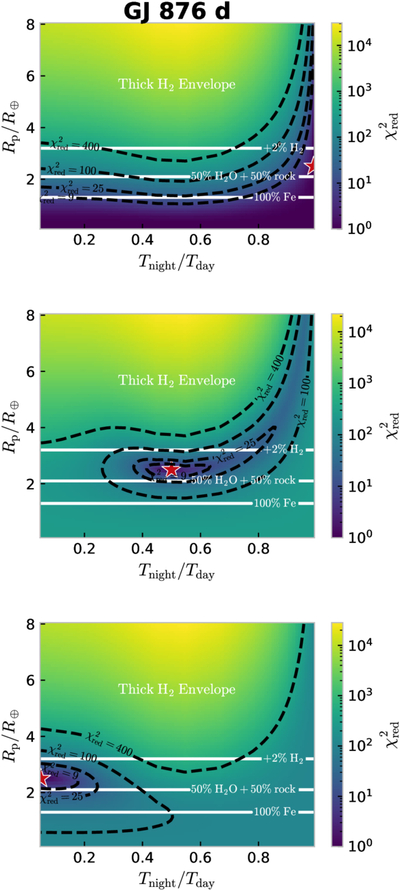
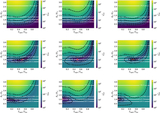
Caption: Figure 6.
﹩{\chi }_{{\rm{red}}}^{2}﹩ model–data comparison for GJ 876 d considering three different scenarios. The star in each panel marks the “true” data parameters. The white curves show theoretical radius calculations based on the assumed planet mass and mass–radius curves from Figure 2 in L. Zeng et al. (2019) for a 100% Fe planet, a planet that is 50% rock and 50% water, and a planet that is equal parts rock and water with the addition of an H2 envelope that is 2% of the total mass. As the planet’s true night–day temperature ratio decreases, we are able to detect the phase curve and rule out a larger swath of radius-redistribution parameter space✎.
Other Images in This Article
Copyright and Terms & Conditions
© 2026. The Author(s). Published by the American Astronomical Society.

