

Image Details
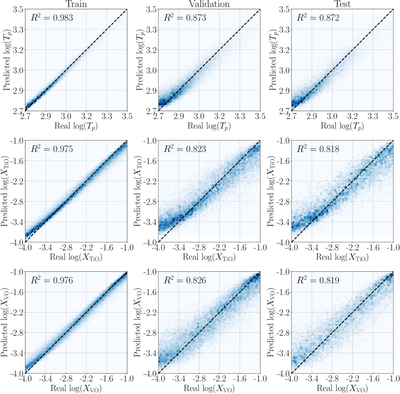
Caption: Figure 5.
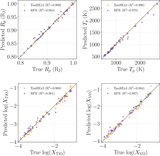
Detailed comparison between the predicted and true values for the three atmospheric parameters in the second-stage model corresponding to the case of Rp ∈ [0.8, 1.0) RJ. Each panel plots the model prediction (y-axis) against the true value (x-axis), with the dashed line marking the ideal 1:1 relation. The three columns correspond to the training, validation, and test datasets. The top row shows results for ﹩\mathrm{log}({T}_{p})﹩, where the predictions closely follow the unity line and retain strong performance even on the test set. The middle row presents predictions for ﹩\mathrm{log}({X}_{{\rm{TiO}}})﹩, which display higher scatter but still preserve a clear linear trend between predicted and true values. The bottom row shows the results for ﹩\mathrm{log}({X}_{{\rm{V\; O}}})﹩, with behavior similar to that of TiO. Across all parameters, the model exhibits the expected decrease in accuracy from training to test data, yet maintains a consistent correlation that demonstrates its ability to recover the main atmospheric trends from broadband photometry.
Other Images in This Article
Show More
Copyright and Terms & Conditions
© 2026. The Author(s). Published by the American Astronomical Society.

