

Image Details
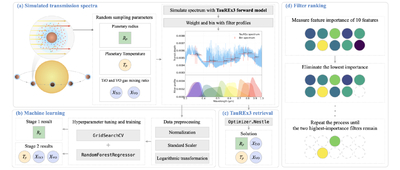
Caption: Figure 2.
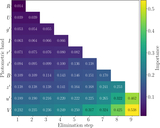
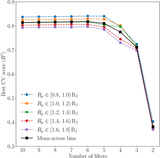
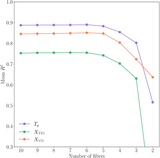
Methodology overview. (a) Synthetic transmission spectra of hot Jupiters are generated with the TauREx3 forward model. The spectra are then weighted and binned using the Johnson–Cousins and SDSS filter transmission profiles to produce 10 broadband transit-depth features. (b) The binned photometry is preprocessed (normalization, standard scaling, and logarithmic transformation) and used to train a two-stage RFR with hyperparameters optimized via GridSearchCV with 5-fold cross-validation: Stage 1 predicts Rp, and the predicted Rp is subsequently used to select the appropriate Stage 2 radius-bin model, which predicts Tp, XTiO, and XVO. (c) In parallel, conventional TauREx3 retrievals are performed (nested sampling) to provide a reference solution for comparison. (d) Filter ranking is obtained from the model feature importances by iteratively removing the least important filter and repeating the training until only the two highest-importance filters remain.
Other Images in This Article
Show More
Copyright and Terms & Conditions
© 2026. The Author(s). Published by the American Astronomical Society.

