

Image Details
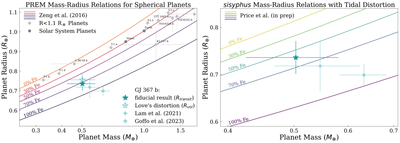
Caption: Figure 3.
Left: mass–radius diagram of exoplanets with <35% mass measurement uncertainty, taken from the NASA Exoplanet Archive (https://exoplanetarchive.ipac.caltech.edu/). The adopted RV mass and transit radius measurements of GJ 367 b from this work (teal star) are shown with those from previous works (light blue points). The teal outlined star represents the volumetric radius if we assume tidal distortion according to Love’s theory (see Section 5). The model curves are based on the Preliminary Reference Earth Model (PREM; A. M. Dziewonski & D. L. Anderson 1981) composition, which is based on the equation of state extrapolated from Earth’s seismic density profile (L. Zeng et al. 2016). Right: modified mass–radius relations for a theoretical planet orbiting GJ 367 with the same orbital period as GJ 367 b, assuming an iron core and perovskite + enstatite mantle composition (see Section 5). The plotted points are the same as in the left panel. When tidal distortion is taken into account in the mass–radius relation, the measured mass and radius from E. Goffo et al. (2023) do not imply a planet denser than iron; assuming a spherical shape in the mass–radius relation for a distorted planet underestimates the volume, leading to an overestimate of bulk density as in the left panel. The mass and radius measured in this work place GJ 367 b between the 50% and 70% iron mass fraction curves, consistent with a composition less iron-rich than Mercury (S. A. Hauck et al. 2013).
Other Images in This Article
Copyright and Terms & Conditions
© 2026. The Author(s). Published by the American Astronomical Society.

