

Image Details
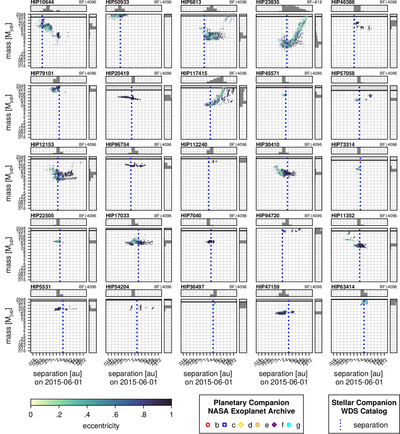
Caption: Figure 14.
Marginal mass–separation posteriors from absolute astrometry for 25 stellar binaries with high-quality orbits published in the Washington Double Star (WDS) catalog. The horizontal gray line indicates the host-star mass, which defines the upper limit of the companion-mass prior we adopted. The 3D separation between the companion and the host star, as calculated from the WDS, is indicated as dashed blue lines for each solution. Companion masses are not reported in this catalog, so we indicate the separations only. Our posteriors infer the “dark mass” of companions under the assumption that they do not significantly contaminate the Gaia photocenter calculations. This assumption breaks down for near-equal-brightness binaries, hence the low-mass estimates in some cases.
Other Images in This Article
Show More
Copyright and Terms & Conditions
© 2026. The Author(s). Published by the American Astronomical Society.

