

Image Details
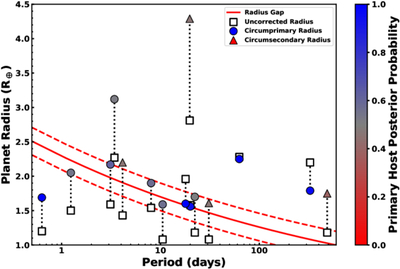
Caption: Figure 8.
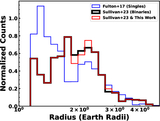
Radius vs. period for the planets analyzed in this work. The empty squares are the uncorrected radii reported in Kepler DR25 (S. E. Thompson et al. 2018). The closed points are the corrected radii, color coded by primary host posterior probability. Planets with a higher circumprimary probability are marked with circles, and the circumprimary radius is used as the corrected radius. Planets with a higher circumsecondary probability are marked with triangles, and the circumsecondary radius is used as the corrected radius. The radius gap is still occupied. These results do not support the presence of a radius gap for planets in binary star systems.
Other Images in This Article
Copyright and Terms & Conditions
© 2026. The Author(s). Published by the American Astronomical Society.

