

Image Details
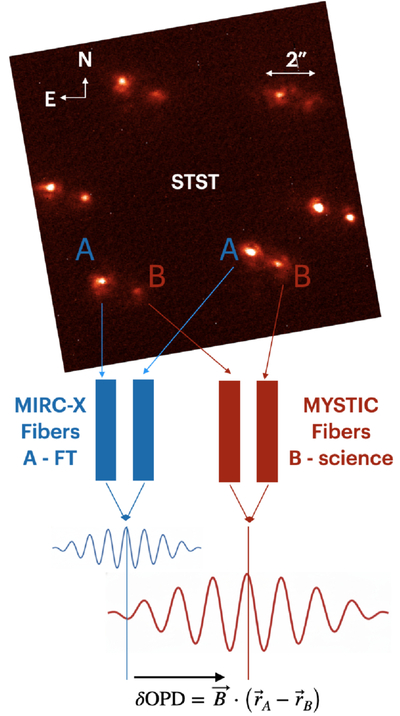
Caption: Figure 1.
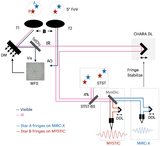
Light from the six 1 m CHARA telescopes is relayed to the beam-combiner laboratory and imaged on the STST camera with a field of view of ∼5″ (N. Anugu et al. 2025). Using the STST camera coordinates of the α Psc A–B pair, flux injection into the single-mode fibers is optimized: the brighter A component into the MIRC-X H-band fibers (blue), and the fainter B component into the MYSTIC K-band fibers (red). Each fiber pair (two-telescope fringes shown for clarity) produces a corresponding white-light fringe packet, whose relative offset is set by the sky separation of the two stars. Here we define the differential OPD between the two stars (and thus between the two channels) as δOPD. The measured fringe-packet separation δOPD therefore yields the instantaneous on-sky astrometric offset between the two stars with submilliarcsecond precision. This dual-field scheme enables simultaneous fringe tracking on the bright component and long-exposure science measurements on the faint component. See detailed optical layout in Figure 4 and implementation in Appendix A.
Other Images in This Article
Copyright and Terms & Conditions
© 2026. The Author(s). Published by the American Astronomical Society.

