

Image Details
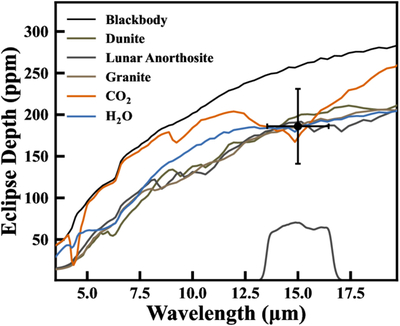
Caption: Figure 6.
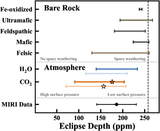
The eclipse depth of GJ 3473 b as a function of wavelength for a range of best-fit bare-rock and atmosphere scenarios that are consistent with the data, as described in Section 4.2. The data for the dunite (ultramafic) and granite (felsic) surfaces are obtained from K. Paragas et al. (2025), while the lunar anorthosite (feldspathic) data are from R. Hu et al. (2012). The free parameter for the bare-rock surfaces was the level of space weathering (in this case, iron), whereas the surface pressure was the free parameter for the atmospheric scenarios (with best-fit values of 0.4 mbar and 34 mbar for CO2 and H2O, respectively). For comparison, the eclipse depth of a blackbody is shown in black.
Other Images in This Article
Copyright and Terms & Conditions
© 2026. The Author(s). Published by the American Astronomical Society.

