

Image Details
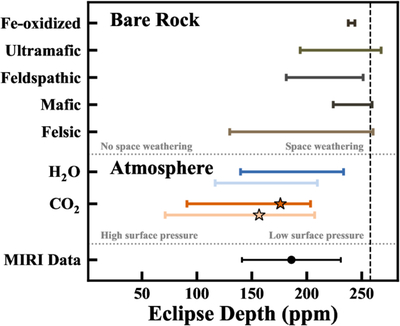
Caption: Figure 5.
The span of eclipse depths of GJ 3473 b in the MIRI F1500W bandpass for different bare-rock and atmosphere scenarios, assuming that the planet is tidally locked in a 1:1 spin-orbit resonance. In the bare-rock cases, the limits arise from different materials, textures, and varying degrees of space weathering, as described in Section 3.1. In contrast, in the atmospheric scenarios, the limits are determined by varying surface pressures, which range from 0.1 mbar to 100 bar, as outlined in Section 3.3. The two shades of color represent Bond albedos of 0 (darker) and 0.3 (lighter), respectively. The stars indicate the critical surface pressure (0.6-1 mbar) below which a CO2 atmosphere is susceptible to collapse, as discussed in Section 5.1. The dashed vertical line represents the eclipse depth of a blackbody. The measured average eclipse depth of GJ 3473 b is shown in black at the bottom of the figure.
Other Images in This Article
Copyright and Terms & Conditions
© 2026. The Author(s). Published by the American Astronomical Society.

