

Image Details
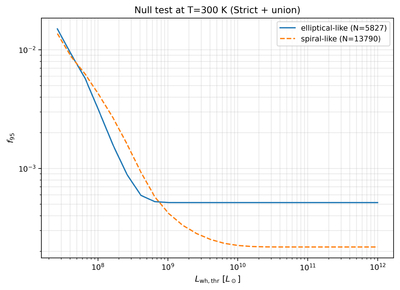
Caption: Figure 8.
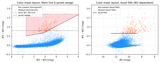
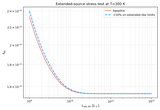
Empirical “null” test at T = 300 K (Strict + union masks). We split the sample by MIR color as a proxy for morphology (“elliptical-like” with W2 − W3 < 1.0 and “spiral-like” with W2 − W3 ≥ 1.0), excluding the Jarrett wedge. The elliptical-like subsample (N = 5, 827) sits on its binomial plateau across the plotted range with f 95 = 3/N = 5.15 × 10⁻⁴, implying that all such galaxies have ﹩{L}_{{\rm{wh}}}^{{\rm{\max }}}\,\leqslant 1{0}^{9}\,{L}_{\odot }﹩ at T = 300 K. The spiral-like subsample (N = 13, 790) behaves like the full sample, approaching the expected plateau f 95 = 3/N = 2.18 × 10⁻⁴ at large thresholds. This demonstrates that ordinary dust-poor systems are intrinsically more constraining, and that our population bounds are not driven by a small set of red outliers.
Other Images in This Article
Show More
Copyright and Terms & Conditions
© 2026. The Author(s). Published by the American Astronomical Society.

