

Image Details
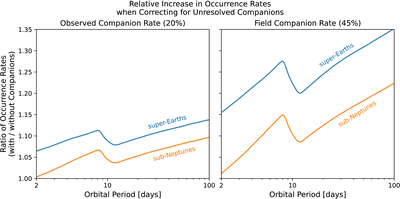
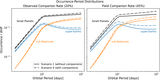
Caption: Figure 6.
The ratio of median occurrence rates from our models with and without a treatment for unresolved stellar companions (Scenario 4 and Scenario 1, respectively), using (left) the observed companion rate and properties, and (right) the field companion rate and blend of observed/simulated undetected properties. The largest changes are for far-out super-Earths (blue; 1–2 R⊕), and the smallest changes are for close-in sub-Neptunes (orange; 2–3.5 R⊕). The kink in these ratios around ∼10 days is due to a slight difference in the best-fit occurrence–period distributions (Figure 7), discussed in Section 4.1.
Other Images in This Article
Copyright and Terms & Conditions
© 2026. The Author(s). Published by the American Astronomical Society.

Copyright ©
2026 Astronomy Image Explorer. All Rights Reserved.
