

Image Details
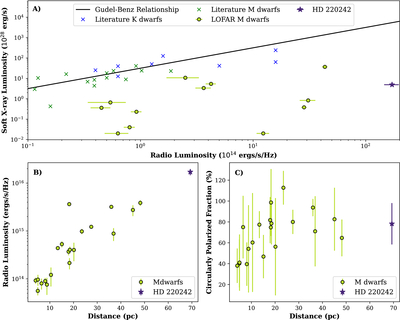
Caption: Figure 4.
(A) Radio luminosities of the LOFAR M dwarf sample (J. R. Callingham et al. 2021) plotted against ROSAT X-ray luminosities. The canonical Güdel–Benz relationship (A. O. Benz & M. Guedel 1994) is plotted as a black line. Included for completeness are the M and K dwarfs originally used to calibrate the relationship (M. Gudel 1992; M. Gudel et al. 1993). While some members of the M dwarf sample lie within the expected scatter of this relationship, the total X-ray luminosity from the HD 220242 system falls far below the expected value if it were to follow this relationship. (B) Radio luminosities of the LOFAR M dwarf sample compared to HD 220242. (C) A comparison between the circularly polarized fraction of LOFAR M dwarfs and HD 220242.
Other Images in This Article
Copyright and Terms & Conditions
© 2026. The Author(s). Published by the American Astronomical Society.

