

Image Details
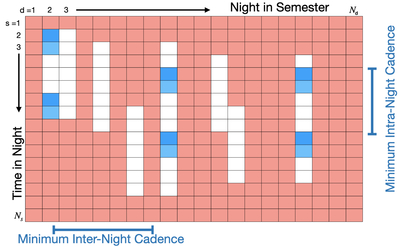
Caption: Figure 1.
Day-slot scheduling framework. AstroQ discretizes time in an observing semester into Nd × Ns slots of equal length, where d and s label each day and slot, respectively. Each request is accessible for a subset of all possible (d, s) pairs, and the inaccessible slots are red. The binary decision variable Yr,d,s is 1 if a visit of request r begins in slot s on day d (shown as dark-blue squares) and 0 otherwise. Here the request specifies tvisit,r = 2 slots to complete a visit. The light-blue cells indicate the (d, s) pairs where no other observations may commence. The request specifies a minimum internight cadence τinter,r of 6 days, i.e., the minimum number of days between successive visits. It also species a minimum intranight cadence τintra,r of three slots.
Other Images in This Article
Copyright and Terms & Conditions
© 2026. The Author(s). Published by the American Astronomical Society.

