

Image Details
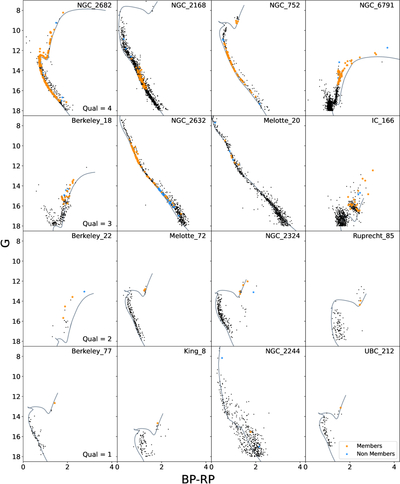
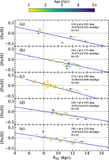
Caption: Figure 1.
A selection of example ESA Gaia CMDs (BP − RP, G) from each of the four quality categories. APOGEE/MWM calibration clusters (Qual = 4) are shown in the first row, high-quality clusters (Qual = 3) with more than five stars in the second, high-quality clusters (Qual = 2) with 2–4 stars in the third, and good clusters (Qual = 1) with only 1 star in the bottom row. The T. Cantat-Gaudin et al. (2020) ESA Gaia-identified, proper motion-selected member stars are shown as black points, OCCAM pipeline-identified MWM/APOGEE members from DR19, adding RV and [Fe/H] selection, are shown as orange stars. The blue stars are proper motion-selected member stars that the OCCAM pipeline has rejected as RV and/or [Fe/H] members. A PARSEC isochrone generated with the mean cluster [Fe/H] from OCCAM, and the distance, reddening, and age from T. Cantat-Gaudin et al. (2020) is plotted in gray. (Note: no effort has been made to adjust/refit the isochrone fit in this work.)
Other Images in This Article
Show More
Copyright and Terms & Conditions
© 2026. The Author(s). Published by the American Astronomical Society.

