

Image Details
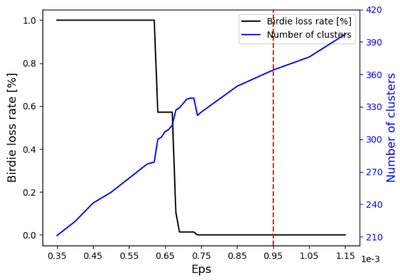
Caption: Figure 6.
Selection of the DBSCAN Eps parameter for identifying candidate ETI signals (MinPts = 5). The plot shows the birdie loss rate [%] (black line; left y-axis) and the number of clusters (blue line; right y-axis) as a function of Eps. The chosen Eps of 9.5 × 10⁻⁴ (indicated by the red dashed vertical line) ensures a 0% Birdie loss rate (guaranteeing all simulated signals are retained) while selecting ETI candidates from hits remaining after RFI removal.
Other Images in This Article
Copyright and Terms & Conditions
© 2026. The Author(s). Published by the American Astronomical Society.

Copyright ©
2026 Astronomy Image Explorer. All Rights Reserved.
