

Image Details
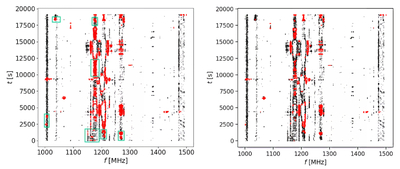
Caption: Figure 4.
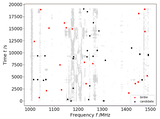
Comparison result between the DBSCAN algorithm and the KNN algorithm for residual RFI mitigation. Data points marked in red represent signals identified and removed as residual RFI, while those in black are retained hits. The left panel shows the waterfall plot after applying the DBSCAN algorithm, demonstrating a residual RFI removal rate of 77.87%. The right panel displays the waterfall plot of the same dataset using the KNN algorithm, achieving a 70.43% removal rate (Y.-C. Wang et al. 2023). Notably, the green boxes in the left panel highlight RFI that DBSCAN effectively mitigation but KNN fails to identify, accounting for approximately 7.44%.
Other Images in This Article
Copyright and Terms & Conditions
© 2026. The Author(s). Published by the American Astronomical Society.

