

Image Details
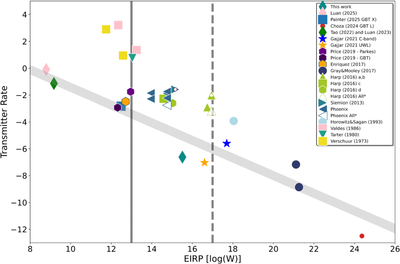
Caption: Figure 6.
Comparison of technosignature survey limits in the plane of transmitter rate vs. sensitivity, following the framework of J. E. Enriquez et al. (2017). The abscissa represents the minimum detectable Equivalent Isotropic Radiated Power (﹩{{\rm{EIRP}}}_{{\rm{\min }}}﹩), and the ordinate denotes the upper limit on transmitter rate, defined as ﹩{({N}_{\star }{\nu }_{{\rm{rel}}})}^{-1}﹩. The dark-cyan diamond marks the constraints established by this work (FAST GC Survey Phase I). Historical and contemporaneous limits are plotted for comparison, with data drawn from: G. L. Verschuur (1973), J. Tarter et al. (1980), F. Valdes & R. A. Freitas (1986), P. Horowitz & C. Sagan (1993), Project Phoenix (P. R. Backus 1998), A. P. V. Siemion et al. (2013), G. R. Harp et al. (2016), R. H. Gray & K. Mooley (2017), D. C. Price et al. (2020), V. Gajjar et al. (2021), Z.-Z. Tao et al. (2022), X.-H. Luan et al. (2023), C. Choza et al. (2024), C. Painter et al. (2025) and X.-H. Luan et al. (2025). The gray band traces the characteristic sensitivity—coverage trend of these prior searches. Our survey’s position in the lower-left quadrant highlights its joint optimization of depth (via FAST’s high gain) and breadth (via the high stellar density of globular clusters and wide L-band coverage).
Other Images in This Article
Copyright and Terms & Conditions
© 2025. The Author(s). Published by the American Astronomical Society.

