

Image Details
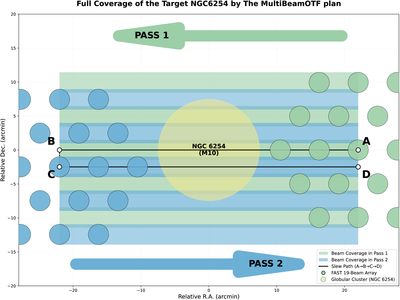
Caption: Figure 5.
Schematic illustration of the OTF raster scan strategy, an adaptation of the MBPS technique for extended targets like the globular cluster NGC 6254 (central yellow circle). The observation follows the precise path A → B → C → D to ensure complete coverage. The first scan (Pass 1) commences at point A, with the 19 beam array (cyan) slewing in the negative R.A. direction to point B. A single, precise step in decl. (﹩{\rm{\Delta }}\,\rm{decl.}\,\simeq 2\mathop{.}\limits^{{\rm{^{\prime} }}}49﹩) is then executed to move the array to point C. From here, the second scan (Pass 2) begins, slewing in the reverse R.A. direction (coral) and concluding the observation at point D. The shaded cyan and coral regions illustrate the sky coverage traced by each of the 19 beams. This two-pass methodology provides complete and overlapping coverage of the target’s full angular extent. Crucially, this strategy preserves the core principle of MBPS: a genuine extraterrestrial signal must appear in the strict temporal and spatial sequence of on-target beam crossings within each pass, a pattern that terrestrial RFI is highly unlikely to replicate.
Other Images in This Article
Copyright and Terms & Conditions
© 2025. The Author(s). Published by the American Astronomical Society.

