

Image Details
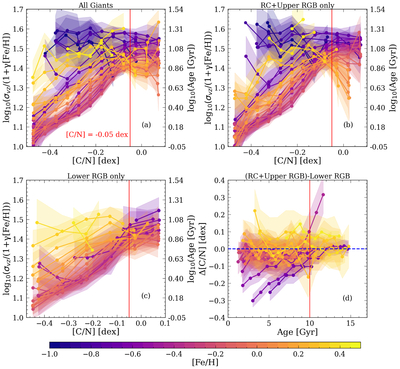
Caption: Figure 8.
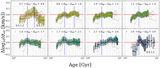
[C/N]–σvz relations in metallicity bins for all giants in plot (a), RCs in plot (b), and lower RGB in plot (c). The y-axes are normalized by the metallicity dependence of the AVR to separate the metallicity effect of the [C/N] relations. Plot (d) shows the difference in [C/N] between the RC and lower RGB stars as a function of the velocity dispersion of the lower RGB stars. The red vertical lines show [C/N] = −0.05 dex, where [C/N] cannot be used to derive stellar age since the velocity dispersion of these stars does not change with [C/N]. There does not exist a relation where the velocity dispersion increases with increasing [C/N] for stars with [Fe/H] < −0.8 dex, mostly due to the fact that they exhibit halo-like kinematics, and thus are similar in age. If we separate stars and look at stars in the low-α disk where an AVR should exist and a larger age range is available, there exists a positive correlation between σvz and [C/N] down to [Fe/H] = −1 dex, suggesting it is possible to infer ages using [C/N] even for low-metallicity stars.
Other Images in This Article
Show More
Copyright and Terms & Conditions
© 2025. The Author(s). Published by the American Astronomical Society.

