

Image Details
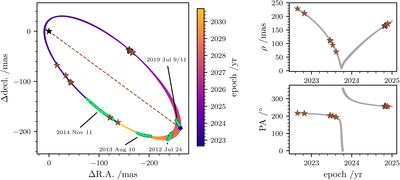
Caption: Figure 3.
One hundred orbits randomly selected from the posterior distribution computed by an MCMC fit to relative astrometry (brown stars). Left: orbits show the displacement of the companion κ Tuc Ab in decl. and R.A. (Δdecl., ΔR.A.) with the primary star κ Tuc Aa in the coordinate center (black star). Colors indicate the position of κ Tuc Ab along the orbits, starting with our first detection on 2022 August 27, and ending after one orbital period. The dashed brown line connects the peri- and apoastron for the best-fit orbital parameters. The blue diamond indicates the tentative position for 2019 July 9/11, which was not used to constrain the orbit. In several past PIONIER and MATISSE observations, κ Tuc Ab was not detected (see Section 5.3), and green points show for the selected orbits its predicted past positions at these epochs that are denoted by text insets. Right: gray curves show for the same orbits as on the left the companion separation ρ and the PA of κ Tuc Ab with PA = 0° to the north and increasing counterclockwise. Figure created with a modified orbitize! plot routine.
Other Images in This Article
Copyright and Terms & Conditions
© 2025. The Author(s). Published by the American Astronomical Society.

