Image Details

Choose export citation format:

EMU Detection of a Large and Low Surface Brightness Galactic SNR G288.8–6.3

  • Authors: Miroslav D. Filipović, Shi Dai, Bojan Arbutina, Natasha Hurley-Walker, Robert Brose, Werner Becker, Hidetoshi Sano, Dejan Urošević, T. H. Jarrett, Andrew M. Hopkins, Rami Z. E. Alsaberi, R. Alsulami, Cristobal Bordiu, Brianna Ball, Filomena Bufano, Christopher Burger-Scheidlin, Evan Crawford, Jayanne English, Frank Haberl, Adriano Ingallinera, Anna D. Kapinska, Patrick J. Kavanagh, Bärbel S. Koribalski, Roland Kothes, Sanja Lazarević, Jonathan Mackey, Gavin Rowell, Denis Leahy, Sara Loru, Peter J. Macgregor, Luciano Nicastro, Ray P. Norris, Simone Riggi, Manami Sasaki, Milorad Stupar, Corrado Trigilio, Grazia Umana, Tessa Vernstrom, Branislav Vukotić

Miroslav D. Filipović et al 2023 The Astronomical Journal 166 .

  • Provider: AAS Journals

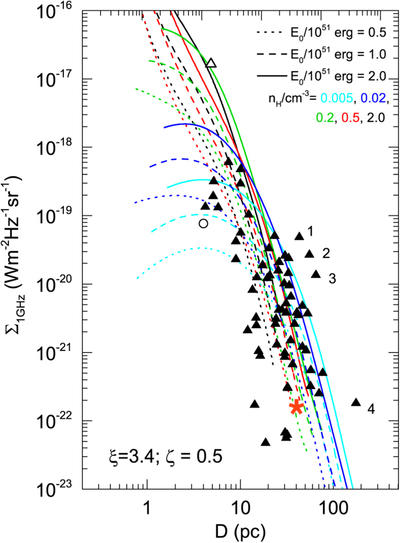
Caption: Figure 4.

Radio surface brightness−diameter diagram for SNRs at a frequency of 1 GHz (black triangles), obtained from numerical simulations (Pavlović et al. 2018, their Figure 3). Our newly detected SNR G288.8–6.3 is marked with a red star in the lower right corner, while Cassiopeia A is shown with an open triangle. The open circle represents the youngest Galactic SNR, G1.9+0.3 (Luken et al. 2020). Numbers represent the following SNRs: (1) CTB 37A, (2) Kes 97, (3) CTB 37B, and (4) G65.1+0.6.

Other Images in This Article
Copyright and Terms & Conditions

Additional terms of reuse