

Image Details
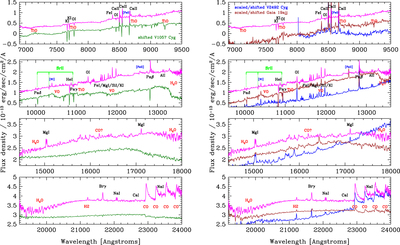
Caption: Figure 10.
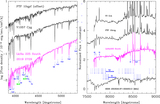
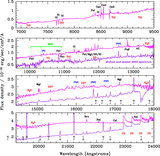
Left panels: comparison of LkHα 225 South (magenta) and V1057 Cyg (green) at infrared wavelengths. These sources are a reasonable match in terms of their absorption features at blue optical wavelengths in low- (Figure 6) and high- (Figure 14) spectral-resolution data. This is also true at red optical wavelengths (top panel), including the TiO emission shared by both sources. At >9000 Å, however, the spectral match is less good, with LkHα 225 South lacking the strong molecular H2O, as well as the TiO, VO, and CO absorption that is seen in V1057 Cyg at these longer wavelengths. The redward side of the J band and the H band does indicate some weak H2O, however. In addition, rather than CO absorption, LkHα 225 South has strong CO emission, as well as other atomic emission lines that are more reminiscent of other types of young-star outbursting sources. Right panels: the same LkHα 225 South spectrum as in the left panels (magenta) now compared to V2492 Cyg (blue) and Gaia 19ajj (brown). LkHα 225 South shares the weak H2O absorption in the J band and H band with Gaia 19ajj, though the TiO and VO patterns differ slightly. The CO emission of LkHα 225 South is more similar to V2492 Cyg than Gaia 19ajj, and the atomic emission-line patterns better match this source, as well. The only atomic absorption in LkHα 225 South is from Sr II (see also Figure 13), which is also seen in both V1057 Cyg and Gaia 19ajj.
Other Images in This Article
Show More
Copyright and Terms & Conditions
© 2022. The Author(s). Published by the American Astronomical Society.

