

Image Details
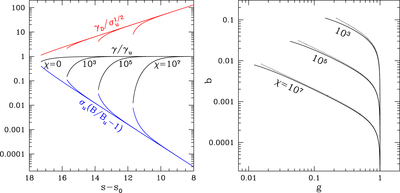
Caption: Figure 8.
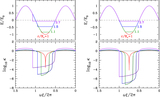
Shock structure solution in the approximation of steady e ± streams (viewed in the shock rest frame). The solution was calculated for χ = 0, 103, 105, and 107. Left: for each case, we show g(s) (black), b(s) (blue), and ﹩{\gamma }_{{\rm{D}}}(s)=B/\sqrt{{B}^{2}-{E}^{2}}﹩ normalized to ﹩\sqrt{{\sigma }_{{\rm{u}}}}﹩ (red). Flows with χ ≫ 1 radiate most of their energy before developing gyration; this results in γ ≪ γ u. Each solution ends where the downstream begins, i.e., where the e ± streams develop gyration (then they become unstable, thermalizing their gyration energy in the drift frame). The drift Lorentz factor γ D at the end point represents the downstream speed relative to the shock. Right: relation between g and b. The approximate analytical solution (Equation (B19)) is shown by the dotted curve and compared with accurate numerical integration (solid curve). Both numerical and analytical solutions are plotted until the e ± streams reach ﹩| {\tilde{\beta }}_{x}| =1/2﹩, which corresponds to 60° gyration in the drift frame.
Other Images in This Article
Copyright and Terms & Conditions
© 2023. The Author(s). Published by the American Astronomical Society.

