

Image Details
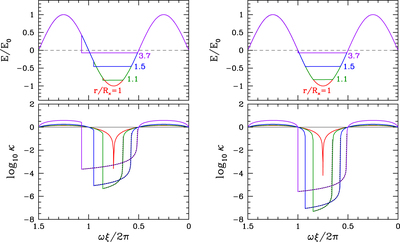
Caption: Figure 5.
Left: evolution of the wave profile E(ξ) and κ(ξ), where ξ ≡ t − r/c. The wave has frequency ν = ω/2π = 10 kHz and initial power L = 1043 erg s−1; the magnetosphere has magnetic dipole moment μ = 1033 G cm3 and density parameter ﹩{ \mathcal N }={10}^{39}﹩. Five snapshots are shown, when the wave packet reaches r/R × = 0.9 (black), 1 (red), 1.1 (green), 1.5 (blue), and 3.7 (magenta). The electric field E is normalized to E 0, which would be the wave amplitude if it propagated in vacuum. The plasma Lorentz factor γ is related to the proper compression κ by γ = (1 + κ 2)/2κ. Black dotted curves show the analytical result for κ(ξ) (Equation (78)). The simulation neglected the shock precursor effect, which can reduce γ in the interval 3π/2ω < ξ < ξ sh (Section 5.5). Right: same wave but now launched into the magnetosphere with ﹩{ \mathcal N }={10}^{37}﹩. Here, κ becomes extremely small, breaking the MHD description and transitioning to a two-fluid regime. We argue in Section 5.3 that the two-fluid calculation will likely give the same evolution of E(ξ) and κ(ξ) as found in the MHD model.
Other Images in This Article
Copyright and Terms & Conditions
© 2023. The Author(s). Published by the American Astronomical Society.

