

Image Details
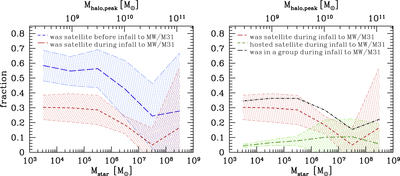
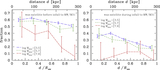
Caption: Figure 4.
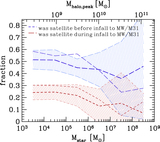
Fraction of all satellite dwarf galaxies at z = 0 that experienced various aspects of group preprocessing prior to falling into the current MW/M31 halo, as a function of satellite stellar mass, Mstar, or subhalo peak mass, ﹩{M}_{\mathrm{peak}}﹩. Left: fraction that were a satellite in a group any time prior to (blue long-dashed curve) or at the time of (red short-dashed curve) falling into the MW/M31 halo. Curves show average over the paired MW/M31 halos, while shaded regions show standard deviation from halo-to-halo scatter. The difference between the two curves is driven by ejected/backsplash satellites that were once within another host halo but then orbited beyond its Rvir. Lower-mass satellites are more likely to have been preprocessed in a group: over half of the lowest-mass (faint and ultrafaint) satellites were. Right: red short-dashed curve shows same as in the left panel, while green long-short-dashed curve shows the fraction that were the central (most massive) galaxy in a group that contained a major satellite (at least ﹩0.1\times ﹩ its ﹩{M}_{\mathrm{star}}﹩) at the time of falling into the MW/M31 halo. The black dot–dashed curve shows the sum of the two curves.
Other Images in This Article
Copyright and Terms & Conditions
© 2015. The American Astronomical Society. All rights reserved.

