

Image Details
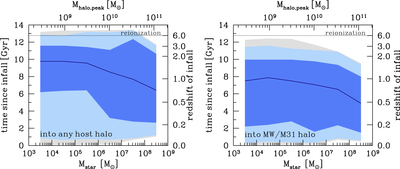
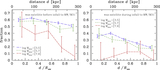
Caption: Figure 1.
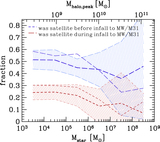
Time since virial infall for satellite dwarf galaxies at z = 0 as a function of their stellar mass, Mstar, or subhalo peak mass, ﹩{M}_{\mathrm{peak}}﹩: time since first crossing within Rvir of any host halo, thus including group preprocessing (left), or time since first crossing within Rvir of the MW/M31 halo (right). Curves show median, shaded regions show 68%, 95%, and 99.7% of the distribution. Satellites at z = 0 have been satellites typically for over half of their history. Lower-mass satellites fell in earlier, though with large scatter. Dotted line at z = 6 marks the end of cosmic reionization; during reionization, ﹩\lt 4\%﹩ of current satellite galaxies were a satellite in a host halo, and none were in the MW/M31 halo, demonstrating that the effects of reionization vs. host-halo environment occurred at distinct epochs, separated typically by 2–4 Gyr, and thus are separable in time theoretically and, in principle, observationally, during satellites’ evolutionary histories.
Other Images in This Article
Copyright and Terms & Conditions
© 2015. The American Astronomical Society. All rights reserved.

