

Image Details
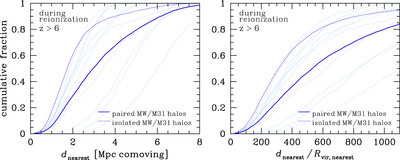
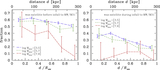
Caption: Figure 3.
For all satellite galaxies at z = 0 with ﹩{M}_{\mathrm{star}}={10}^{3-9}\;\;{M}_{\odot }﹩, cumulative distribution of the distance to the nearest, more massive halo, ﹩{d}_{\mathrm{nearest}}﹩, that they experienced during cosmic reionization (﹩z\gt 6﹩). Left panel shows comoving distance, and right panel shows this distance scaled to Rvir of the nearest halo. Solid thick curve shows average over all satellites in the paired MW/M31 halos, while thin curves show satellites in each pair, to indicate the pair-to-pair scatter. We find no dependence on satellite mass. The typical distance was ﹩3\;\mathrm{Mpc}﹩ comoving (﹩\sim 400\;\mathrm{kpc}﹩ physical), or ﹩500\;{R}_{\mathrm{vir}}﹩; at these distances, dwarf galaxies in the Local Group do not show strong environmental influence. These results strongly support that the effects of the host-halo environment occurred well after the effects of reionization during the histories of surviving satellites. For comparison, the dotted curve shows the average across the isolated MW/M31 halos, whose satellites experienced ﹩\sim 1/2﹩ the distance (see the Appendix).
Other Images in This Article
Copyright and Terms & Conditions
© 2015. The American Astronomical Society. All rights reserved.

