

Image Details
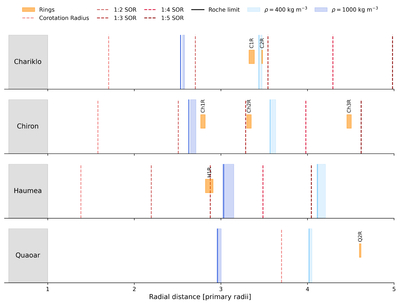
Caption: Figure 4.
Normalized radial locations of the rings, disruption limits, and spin–orbit resonances (SORs) for the Chariklo, Chiron, Haumea, and Quaoar systems. The gray shaded region marks the central body, while the orange vertical bands indicate the observed radial extent of the rings. The dashed vertical lines show the corotation radius and the theoretical SOR locations. The vertical solid lines mark the classical Roche limit, while the shaded regions show the radial interval spanned by the minimum and maximum disruption limits obtained for different values of Ψ. Both quantities are computed for two different bulk densities of the ring particles: ρ = 400 kg m−3 (light blue) and ρ = 1000 kg m−3 (blue). The former represents porous icy particles, while the latter corresponds to compact icy particles. The physical and orbital parameters of the Quaoar and Chiron systems were taken from B. E. Morgado et al. (2023), C. L. Pereira et al. (2023), B. Proudfoot et al. (2025a, 2025b), and C. L. Pereira et al. (2025), respectively, while those of Chariklo and Haumea were taken from F. Braga-Ribas et al. (2014) and J. L. Ortiz et al. (2017), respectively.
Other Images in This Article
Copyright and Terms & Conditions
© 2026. The Author(s). Published by the American Astronomical Society.

