

Image Details
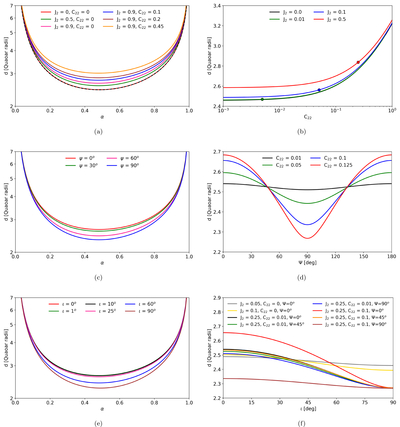
Caption: Figure 2.
Disruption limit and satellite equilibrium figures as a function of the primary’s quadrupolar gravity field and orientation. Panels (a) and (b) show the effect of J2 and C22 for Ψ = ι = 0°: (a) equilibrium distance d/Rp as a function of α = c/a, and (b) disruption limit as a function of C22 for different J2. Panels (c) and (d) show the effect of Ψ: (c) equilibrium curves for J2 = 0.25, C22 = 0.1, and ι = 0°, and (d) disruption limit for different C22, with J2 = 0.25 and ι = 0°. Panels (e) and (f) similarly show the effect of ι: (e) equilibrium curves for J2 = 0.25, C22 = 0.1, and Ψ = 0°, and (f) disruption limits for different combinations of J2, C22, and Ψ. The colored dots in panel (b) indicate the maximum values of C22 allowed for a triaxial primary, C22 ≤ 0.5J2. Following the physical properties of Quaoar, we assume mp = 1.2 × 10²¹ kg, a satellite-to-primary mass ratio of ms/mp = 10−3, and equal bulk densities for the primary and satellite, ρp = ρ = 1676 kg m−3 (B. Proudfoot et al. 2025a).
Other Images in This Article
Copyright and Terms & Conditions
© 2026. The Author(s). Published by the American Astronomical Society.

