

Image Details
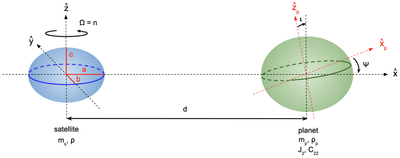
Caption: Figure 1.
Schematic representation of the dynamical model, composed of a primary and a satellite with masses mp and ms, and bulk densities ρp and ρ, respectively. The center-to-center distance between the two bodies is d. The rotating frame (x, y, z) is centered on the satellite and rotates about the satellite spin axis with angular frequency Ω. The satellite is assumed to be synchronously rotating (Ω = n), and its principal axes remain aligned with the rotating frame: the axes x, y, and z coincide with the triaxial axes a, b, and c, respectively. The triaxial primary, whose gravitational field is described by the coefficients J2 and C22, is located along the x-axis. The primary-fixed frame (xp, yp, zp) is oriented such that zp coincides with the primary polar axis, while xp and yp lie in its equatorial plane. The angle ι defines the inclination of the primary polar axis with respect to the normal to the satellite orbital plane, whereas Ψ defines the orientation of the primary’s long axis within its equatorial plane relative to the satellite-primary geometry.
Other Images in This Article
Copyright and Terms & Conditions
© 2026. The Author(s). Published by the American Astronomical Society.

