

Image Details
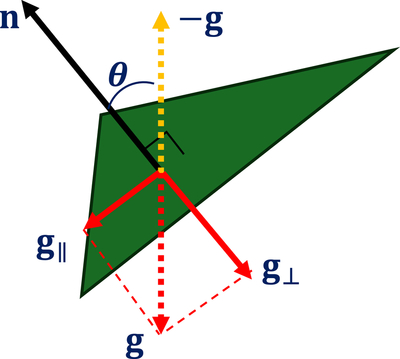
Caption: Figure 2.
The definition of gravity-referenced slope and downslope azimuth. For each surface facet, ﹩{\bf{n}}﹩ is the outward unit normal vector, and ﹩{\bf{g}}﹩ is the local effective-gravity vector. The gravity-referenced slope angle ﹩\theta ﹩ is the angle between ﹩{\boldsymbol{n}}﹩ and the upward opposite-gravity direction, ﹩-{\boldsymbol{g}}﹩. The tangential component of effective gravity, ﹩{{\bf{g}}}_{\parallel }﹩, defines the downslope direction in the local tangent plane, where ﹩{{\bf{g}}}_{\perp }﹩ is the component normal to the facet. The downslope azimuth is computed from ﹩{{\bf{g}}}_{\parallel }﹩ and summarized using circular statistics.
Other Images in This Article
Copyright and Terms & Conditions
© 2026. The Author(s). Published by the American Astronomical Society.

