

Image Details
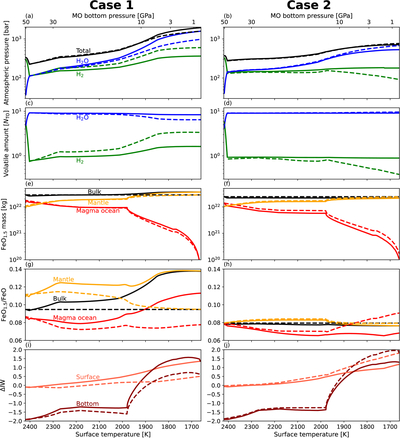
Caption: Figure 9.
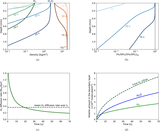
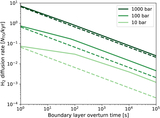
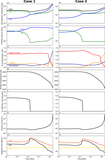
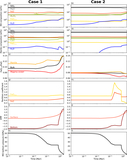
Comparison between the evolution calculated in this study, which includes the oxygen mass balance associated with redox reactions between the atmosphere and magma ocean (solid lines), and a calculation that neglects the atmospheric influence on the oxygen fugacity of the magma ocean, in which the atmospheric composition is determined as a dependent variable of the magma ocean oxygen fugacity (dashed lines). The initial H2+H2O amount is 10NTO and the initial magma ocean bottom pressure is 50 GPa, as in Figures 6 and 7. The left and right columns show the results of Case 1 and Case 2, respectively. The lower horizontal axis is the surface temperature, and the upper horizontal axis is the magma ocean bottom pressure. (a), (b) Atmospheric pressure of the total (black), H2 (green), and H2O (blue). (c), (d) Total amounts of H2 (green) and H2O (blue). (e), (f) FeO1.5 mass in the bulk interior (black), magma ocean (red), and mantle (orange). (g), (h) Molar FeO1.5/FeO ratio in the bulk interior (black), magma ocean (red), and mantle (orange). (i), (j) Oxygen fugacity relative to the IW buffer at the surface (pink) and the magma ocean bottom (brown).
Other Images in This Article
Copyright and Terms & Conditions
© 2026. The Author(s). Published by the American Astronomical Society.

