

Image Details
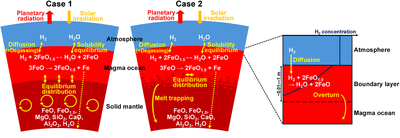
Caption: Figure 1.
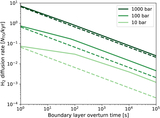
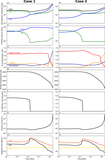
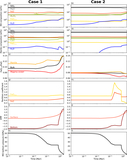
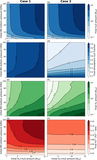
Schematic overview of the coupled atmosphere-interior evolution model. This model considers the diffusion of atmospheric H2 into the magma ocean, redox reactions in the magma ocean, partitioning of oxide components and H2O among each phase, and cooling through thermal planetary radiation, with Fe produced by Fe2+ disproportionation removed into the core as it forms. Cases 1 and 2 represent two end-member treatments of material exchange between the magma ocean and solid mantle, introduced to account for uncertainty in the efficiency of material exchange between these reservoirs. Case 1 assumes efficient material exchange and equilibrium partitioning of oxide components and H2O between the bulk magma ocean and solid mantle with uniform chemical compositions. Case 2 assumes inefficient material exchange, in which melt is efficiently trapped in the rheological transition region without subsequent material mixing in the solid mantle. The melt-side boundary layer at the interface between the magma ocean and atmosphere is considered to evaluate the H2 diffusion rate into the magma ocean, with its overturn frequency determined by buoyancy-driven convective instability.
Other Images in This Article
Copyright and Terms & Conditions
© 2026. The Author(s). Published by the American Astronomical Society.

