

Image Details
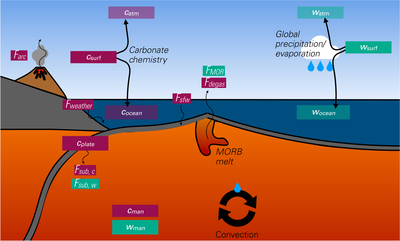
Caption: Figure 2.
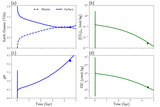
A schematic showing the atmospheric sources and sinks that define the new volatile cycling processes in VPLanet’s ThermInt module, inspired by Figure 1 in B. J. Foley (2015). Fluxes related to CO2 are color-coded magenta, and fluxes related to H2O are color-coded teal. We incorporate the climate-stabilizing carbon cycle from B. J. Foley (2015), tracking the mass of CO2 across the mantle (cman), plate (cplate), and surface (csurf) reservoirs. We include the deep water cycle from J. Seales & A. Lenardic (2020), and a precipitation/evaporation parameterization from P. Driscoll & D. Bercovici (2013), which allow us to track the mass of H2O across the mantle (wman) and surface (wsurf) reservoirs. At each time step, surface carbon and water are partitioned into the atmosphere (catm, watm) and the ocean (cocean, wocean) by enforcing equilibrium at the air–water boundary. This schematic does not depict the modeled ocean chemistry.
Other Images in This Article
Copyright and Terms & Conditions
© 2026. The Author(s). Published by the American Astronomical Society.

