

Image Details
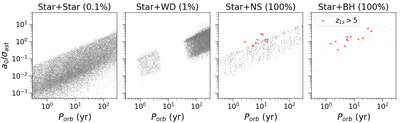
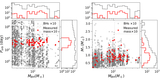
Caption: Figure 8.
Detectability of binaries in the contiguous GBTDS fields, broken down by binary type. The number in parentheses indicates the fraction of the population that is shown in the figure; as there are many more star+star binaries than BH+star binaries, we only show a small fraction of the former for clarity. Gray points indicate sources with F146Vega < 23.5 mag; red points indicate the subset of those which are astrometrically detectable (z1s > 5). The positive correlation is due to Kepler’s third law as Porb ∝ a3/2, which is then modulated by scatter in δql, ϖ, and σast. Roman is most sensitive (i.e., large z1s) to periods of 1 − 10 yr. The gap in the WD distribution is due to the choice made in population synthesis (Section 4.1).
Other Images in This Article
Copyright and Terms & Conditions
© 2026. The Author(s). Published by the American Astronomical Society.

