

Image Details
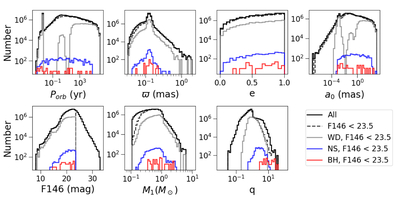
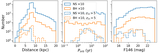
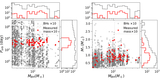
Caption: Figure 3.
Simulated luminous binary population properties (orbital period Porb, parallax ϖ, eccentricity e, angular photocenter orbit semimajor axis a0, F146 magnitude, primary mass M1, and mass ratio q) for the contiguous GBTDS fields. The solid black line denotes the distribution for all sources within 30 kpc. The dashed black line denotes the subset (∼80%) that are F146Vega < 23.5 mag (source-dominated regime). The gray, blue, and red outlines denote the population of WD, NS, and BH binaries, respectively, with F146Vega < 23.5 mag. Note that the primary is defined to be the brighter component of the binary, and the mass ratio is defined to be the ratio of the secondary to the primary; this can lead to q > 1, especially in the case of BH+star binaries.
Other Images in This Article
Copyright and Terms & Conditions
© 2026. The Author(s). Published by the American Astronomical Society.

