

Image Details
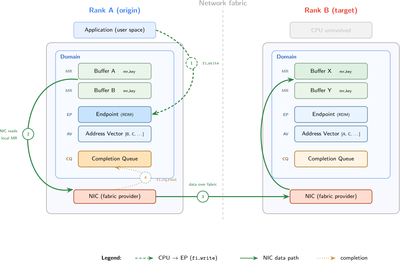
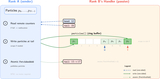
Caption: Figure 1.
OFI (libfabric) architecture and one-sided RDMA write in four steps. (1) The application on Rank A issues an RDMA operation (e.g., fi_write), specifying the local buffer’s memory descriptor, the remote buffer’s address and memory-region key, and the target’s fi_addr_t from the Address Vector. (2) The NIC reads the source data from the local registered Memory Region. (3) The NIC transmits the data over the network fabric and writes it directly into Rank B’s registered Memory Region—without involving Rank B’s CPU. (4) A completion entry is posted to Rank A’s Completion Queue, which the application polls via fi_cq_read to detect that the operation has finished. Each rank maintains a single reliable datagram (RDM) endpoint shared across all peers; remote ranks are addressed through an address vector. Memory regions and the endpoint are grouped within a domain for resource scoping and access control.
Other Images in This Article
Copyright and Terms & Conditions
© 2026. The Author(s). Published by the American Astronomical Society.

